It has happened a few times over the past couple of years that someone will come up to me with some piece of mathematics that they're having trouble with and ask me if I can help them with it. I'll have a look over it and say something along the lines of "I'm not familiar with this specifically, but I think I should be able to pick it up pretty easily". The usual response to this involves some degree of indignation.
Of course I understand why. Nobody likes to feel stupid or belittled, and this is certainly not my intention, but I can see how someone might feel that way. If I were in that position it would probably be my first response as well. But with that said, I don't think it's an entirely reasonable one.
I'm not trying to show off how clever I am. They were the ones to come to me asking for my help (and if I can I try my best to). Presumably they came to me because they expected I had some degree of expertise, but I get the impression the sort of expertise they were expecting was that of having been taught the subject previously. Sometimes this is the case of course, but mathematics is such a broad topic that you will rarely have seen everything at a sub-postgraduate level no matter how educated you are.
The point of having gone to university and graduated with a degree (even a bachelor's) specialising in mathematics or a mathematics-heavy field like physics is not to simply learn as much of a field as you can and leave it there. The point is to equip yourself with the tools to teach yourself new things, and I hope to some extent I have managed to do that. I've taught myself things I never saw at university and so I know my limitations. Some concepts and techniques I'm reasonably familiar with and others I'm not; some things take more time and more effort to learn than others. It just happens that through study and experience I've managed to achieve the minimal level of competence to teach myself what they're having trouble with.
So my exasperation does not come from a place of ignorance. I have struggled with maths in the past, I know what it's like. The fact remains, however, that my degree would be worth very little if I hadn't picked up the ability to learn high school- or early undergraduate-level maths with relative ease. If someone's problem left me just as nonplussed as they were, then I should probably be seeking partial reimbursement from my university. I certainly hope they don't take it as a personal slight; I have no doubt that if they had studied what I had then they would have just as little trouble with their present difficult as I might (and, I would hazard, quite possibly even less so).
Showing posts with label Anecdotes. Show all posts
Showing posts with label Anecdotes. Show all posts
Thursday, April 3, 2014

Saturday, May 29, 2010
An Interesting Discussion
I'm currently studying a minor sequence in philosophy at university, and one of my current subjects (one week from completion, I might add) is on the topic of ethics (it's styled as an introduction to ethics, being a first year course). As a part of this course, we have a weekly hour of discussion in our tutorial group about the previous week's lectures. Naturally, such an open-ended discussion did not always conform to this expectation - on better days we would stray on to more recent lectures, on worse days we would talk about other philosophical areas of study such as metaphysics, and on a few occasions I found myself in a discussion (if it can be called that) which consisted of little more than a handful of forced comments on the topic at hand followed by an inane conversation about the latest developments in so-and-so's social life.
Now, as I mentioned, there were good days, and a couple of those were real crackers. The most recent of these saw myself and "the usuals" whom I normally sat with talking about that week's lectures, which were on abortion and infanticide. Out of the first awkward comments eventually came one person with an especially strong position; he was quite firmly against abortion, and he was happy to try and defend that position, a position he found at odds with the university's "very left-wing" philosophy department, which he noted was sadly like that of Melbourne and unlike that of several universities in the United States. If you had not guessed already, yes, it turns out he is a Christian, and I would guess something of a more conservative one at that. However, on this day and at this time, I didn't know any of that. All I knew was he was against abortion, and he had some reasons.
Now, I believe that if we're going to debate right and wrong, we should see all acts as morally acceptable until shown to be wrong. That's not to be taken as some overarching principle, more a guideline for tolerable behaviour. Some things I should think are prima facie wrong, and so would not enjoy much time in being considered acceptable (that's not to say that they were once fine and now are not, only that they were once seen as fine). My point here is that the burden of proof should lie with he who wants to say an action is wrong, not with who wants to say an action is right. This is just an opinion here, and I'll not offer justification for it (not any time soon, certainly) but since it really only applies to debates I don't see the need. I personally think it's a reasonable position to take. Had I been of lucid enough mind to recall this, I might have pressed this certain gentleman on his claim that by refuting arguments for abortion he has shown abortion is wrong - he would need to offer some sort of positive argument for his case.
Alas, I did not, and so our miniature debate, adjudicated by my friend Tyson, was less about abortion and more about this fellow's objections to Judith Jarvis Thomson's famous Violinist analogy. He seemed to be of the opinion (one that was never stated outright I should note) that because her analogy was invalid, his position was right. Clearly logically this does not follow, but I did not press him, as I mentioned, because I was perhaps too preoccupied with the debate we were having at the time. Now, I don't support Thomson necessarily, I find her ideas interesting but from as a virtue ethicist I'm not convinced by them. To paraphrase my tutor's comments on Singer (my tutor also being virtue-inclined), we're not even on the same wavelength.
I'll not describe our little argument in any detail because not only was it frustrating to participate in, the recollection surely capable of driving me to tears, the precise nature of his arguments are not the primary topic of this post. He had four points, three of which we properly debated. The final was not resolved in time, but I would say that with some assistance from my tutor (by the end I was exhausted) I had shown that at least two of them were severely flawed if not entirely refuted. But again, this is unimportant. After we touched on three of his Violinist counter-arguments, we got slightly sidetracked (as we are wont to do in these tutorials) and began talking about ethical perspectives - I demanded that he provide some justification other than 'most people would agree' or, if he didn't want to go into depth, his guarantee that he at least had some other justification, a demand which he refused. He then turned on me, and demanded I provide justifications for my beliefs. This was something of a non-sequitur, as I was not defending my own position but someone else's, and I let him know as much, along with protests that my own position was complicated.
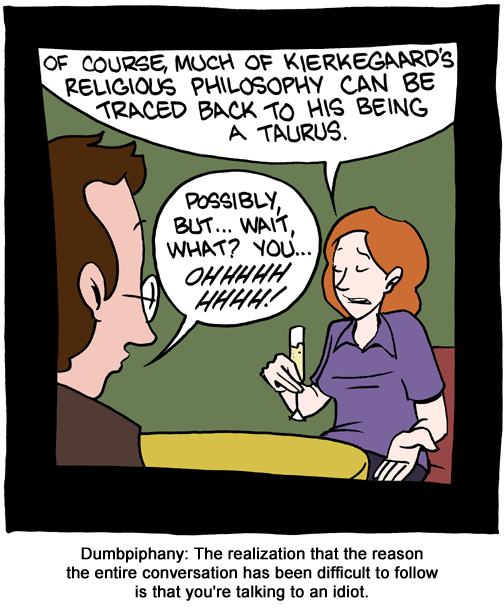
Like a fool, however, the more he pressed, the more I relinquished and gave him the two-minute summary of the entirety of virtue ethical theory, something he was less than convinced by. He grilled me about details, extrapolating from my summary, ventured into meta-ethics, and generally caught me, tired and unprepared, by surprise. This was relieved by a rare interjection from one of the others in the group, who turned his questioning back on to him. His response, which is the main point of this topic, was a moment which Tyson later remarked to me as being a "dumbpiphany" (a reference to this Saturday Morning Breakfast Cereal comic (a webcomic we both enjoy)) and it started with the phrase, "Well, I'm coming from a Christian perspective, so...".
He didn't say much of substance after that, so I imagine his saying that was supposed to explain everything that needed to be explained. But what does that statement mean, exactly? Ok, he's a Christian, so what? So he's against abortion automatically? And everything he says is just an attempt to justify a belief he takes for granted as true? That doesn't seem very fair, but what else could it mean? He mentioned that Christians in philosophy courses aren't very open about it, as though this were a bad thing. Christians in science courses aren't very open about their Christianity either, because it's not relevant. Why should it be? There is a reason that ethics in analytic philosophy is secular, and that's because appeals to religion necessarily either reduce to arguments about God or tradition. Since the current consensus seems to be that we can never know if any god exists and it is something which must be taken on faith, that leaves the apologist in a difficult situation. Philosophy is about argument and rationality; if a rational person can't accept your position as being a reasonable one (though that person may not agree) then your position isn't worth consideration. I will tell you now that any argument which requires the person being persuaded or convinced to have faith that the argument is already valid is never ever going to be a good one, because it can only work on people who already agree with you. How can you expect anyone to take that position seriously?
Now, when I recounted this story to a friend of mine who was not present (telling it to someone who was would be quite boring for them, I imagine) his reaction to my shock at this supposed philosophical position was that I should be careful and hold in mind that he himself was Christian. I will tell you now that I have nothing against Christians in general, and I don't simply like ragging on a Christian philosophy student because I'm a big bad atheist and it gives me the jollies. The fact that he was Christian was irrelevant - the fact that he tried to use his religion to justify his stance was what shocked me, and the fact that he was blindly proud of what 'courage' it took to do that is what appalled me. It's not a question of religion and it's not even a question of attitude. The point is that, if look through the prism of reason vs. faith, that old dichotomy, modern philosophy falls firmly within the sphere of reason, and that is absolutely where it belongs. If "My god says so," or "My Holy Book instructs as such," become valid points of view ethically speaking, then literally any action could be considered completely justifiable. If so, then what is the point of ethics? If it is to be any good, it has to apply to more than one person or one group or one dogma; it must be able to apply to everyone.
Now, as I mentioned, there were good days, and a couple of those were real crackers. The most recent of these saw myself and "the usuals" whom I normally sat with talking about that week's lectures, which were on abortion and infanticide. Out of the first awkward comments eventually came one person with an especially strong position; he was quite firmly against abortion, and he was happy to try and defend that position, a position he found at odds with the university's "very left-wing" philosophy department, which he noted was sadly like that of Melbourne and unlike that of several universities in the United States. If you had not guessed already, yes, it turns out he is a Christian, and I would guess something of a more conservative one at that. However, on this day and at this time, I didn't know any of that. All I knew was he was against abortion, and he had some reasons.
Now, I believe that if we're going to debate right and wrong, we should see all acts as morally acceptable until shown to be wrong. That's not to be taken as some overarching principle, more a guideline for tolerable behaviour. Some things I should think are prima facie wrong, and so would not enjoy much time in being considered acceptable (that's not to say that they were once fine and now are not, only that they were once seen as fine). My point here is that the burden of proof should lie with he who wants to say an action is wrong, not with who wants to say an action is right. This is just an opinion here, and I'll not offer justification for it (not any time soon, certainly) but since it really only applies to debates I don't see the need. I personally think it's a reasonable position to take. Had I been of lucid enough mind to recall this, I might have pressed this certain gentleman on his claim that by refuting arguments for abortion he has shown abortion is wrong - he would need to offer some sort of positive argument for his case.
Alas, I did not, and so our miniature debate, adjudicated by my friend Tyson, was less about abortion and more about this fellow's objections to Judith Jarvis Thomson's famous Violinist analogy. He seemed to be of the opinion (one that was never stated outright I should note) that because her analogy was invalid, his position was right. Clearly logically this does not follow, but I did not press him, as I mentioned, because I was perhaps too preoccupied with the debate we were having at the time. Now, I don't support Thomson necessarily, I find her ideas interesting but from as a virtue ethicist I'm not convinced by them. To paraphrase my tutor's comments on Singer (my tutor also being virtue-inclined), we're not even on the same wavelength.
I'll not describe our little argument in any detail because not only was it frustrating to participate in, the recollection surely capable of driving me to tears, the precise nature of his arguments are not the primary topic of this post. He had four points, three of which we properly debated. The final was not resolved in time, but I would say that with some assistance from my tutor (by the end I was exhausted) I had shown that at least two of them were severely flawed if not entirely refuted. But again, this is unimportant. After we touched on three of his Violinist counter-arguments, we got slightly sidetracked (as we are wont to do in these tutorials) and began talking about ethical perspectives - I demanded that he provide some justification other than 'most people would agree' or, if he didn't want to go into depth, his guarantee that he at least had some other justification, a demand which he refused. He then turned on me, and demanded I provide justifications for my beliefs. This was something of a non-sequitur, as I was not defending my own position but someone else's, and I let him know as much, along with protests that my own position was complicated.
Like a fool, however, the more he pressed, the more I relinquished and gave him the two-minute summary of the entirety of virtue ethical theory, something he was less than convinced by. He grilled me about details, extrapolating from my summary, ventured into meta-ethics, and generally caught me, tired and unprepared, by surprise. This was relieved by a rare interjection from one of the others in the group, who turned his questioning back on to him. His response, which is the main point of this topic, was a moment which Tyson later remarked to me as being a "dumbpiphany" (a reference to this Saturday Morning Breakfast Cereal comic (a webcomic we both enjoy)) and it started with the phrase, "Well, I'm coming from a Christian perspective, so...".
He didn't say much of substance after that, so I imagine his saying that was supposed to explain everything that needed to be explained. But what does that statement mean, exactly? Ok, he's a Christian, so what? So he's against abortion automatically? And everything he says is just an attempt to justify a belief he takes for granted as true? That doesn't seem very fair, but what else could it mean? He mentioned that Christians in philosophy courses aren't very open about it, as though this were a bad thing. Christians in science courses aren't very open about their Christianity either, because it's not relevant. Why should it be? There is a reason that ethics in analytic philosophy is secular, and that's because appeals to religion necessarily either reduce to arguments about God or tradition. Since the current consensus seems to be that we can never know if any god exists and it is something which must be taken on faith, that leaves the apologist in a difficult situation. Philosophy is about argument and rationality; if a rational person can't accept your position as being a reasonable one (though that person may not agree) then your position isn't worth consideration. I will tell you now that any argument which requires the person being persuaded or convinced to have faith that the argument is already valid is never ever going to be a good one, because it can only work on people who already agree with you. How can you expect anyone to take that position seriously?
Now, when I recounted this story to a friend of mine who was not present (telling it to someone who was would be quite boring for them, I imagine) his reaction to my shock at this supposed philosophical position was that I should be careful and hold in mind that he himself was Christian. I will tell you now that I have nothing against Christians in general, and I don't simply like ragging on a Christian philosophy student because I'm a big bad atheist and it gives me the jollies. The fact that he was Christian was irrelevant - the fact that he tried to use his religion to justify his stance was what shocked me, and the fact that he was blindly proud of what 'courage' it took to do that is what appalled me. It's not a question of religion and it's not even a question of attitude. The point is that, if look through the prism of reason vs. faith, that old dichotomy, modern philosophy falls firmly within the sphere of reason, and that is absolutely where it belongs. If "My god says so," or "My Holy Book instructs as such," become valid points of view ethically speaking, then literally any action could be considered completely justifiable. If so, then what is the point of ethics? If it is to be any good, it has to apply to more than one person or one group or one dogma; it must be able to apply to everyone.
Saturday, April 4, 2009
Easter service
Yesterday, as a matter of course I attended a church service for the beginning of the Easter break. Due to no fault of those running the mass (except perhaps for the dramatisation of the denial of Peter, which was... interestingly executed) my experience was less than pleasant up until the point where the guest minister, who ordinarily takes mass at that church, made an 'Easter address'. From speaking to a good number of people afterwards, I found many people to have found it exceedinly unsatisfactory, as did I. Though my memory is not as sharp is it was a day ago, I will try to list and address some of the Reverend's points.
First of all, the Reverend went to quite a bit of trouble to make sure everyone present did not think he was delusional, repeating quite a number of times (an unnecessary number of times, to be honest) that from his own and presumably our experience, we do not generally see dead people amongst the living. While this is true enough, where he went from there somewhat upset me. He stated that likewise, the Apostles believed that Jesus, having been crucified, was dead and gone. And so, to suggest that Jesus was not resurrected would be to accuse them of being simpletons and imbeciles as they claimed to have witnessed him in the flesh and heard reports of his tomb left empty and bare, as if they were not capable of comprehending death. He then went on to say that we in the 21st century were not so much smarter than those in the 1st century (and if he is referring to capacity for intelligence rather than knowledge itself, then I agree wholeheartedly) and was quick to denounce anyone foolish enough to think we are so much smarter than they were. He may have even been alluding to the fact that knowledge is not learnt and forgotten, but constantly built upon; it would take just as long today to deduce Pythagoras' Theorem as it did for Pythagoras himself if we had the same degree of mathematical knowledge, after all.
The problem is that though this argument is at first compelling, it is seriously flawed, and while his secondary point is valid, he disgusts me the way he uses it. If everything in the Bible was true (an impossibility due at the very least due to discontinuity) then perhaps to suggest that Jesus didn't rise from the dead would be an insult to those first disciples; but the Bible cannot be entirely infallible, and even if it was a reasonably accurate account of what it is supposed to, even then by the very fact that it should be claimed as a historical source it must be taken with a grain of salt, because we cannot be sure now what happened 2000 years ago: this is a very basic tenet of historical study. No source can be trusted entirely.
Now, naturally, people don't think that disbelieving in Jesus is supposed to be insulting anybody, not by itself, and so one might expect their reaction, after the original knee-jerk of embarrassed shame, to be to question the premise of the claim, as I have. This is why he brought up the second point; before anyone has the time to question it, he throws in as evidence a fact. That the fact happens to be irrelevant given that the premise is false is inconsequential so long as the premise is not questioned; in the oppressive and stifling environment of a church packed to if not beyond its maximum capacity, few will bother to take the thought any further, and so will be taken in. It's dishonest and insulting to say the least, but keep in mind that the tactic he used, a distraction, is one used in so many persuasive features subconsciously that I shouldn't be surprised if he did it without thinking. And given his job requires proselytisation, he can almost be forgiven for giving it a go.
However, the fact remains that people do not like to be converted; conversion requires renunciation of previous beliefs, and so can only occur on the prior assumption that they are false, and people do not like to be told that what they believe is incorrect, which is something I try vehemently to avoid. An open minded person will be open to discussion and discourse, but nobody would openly seek conversion- that would defy logic. I think this is why many people were upset, as I was (but many even more so) by the sermon. But it did not end there.
While naturally there were other less important parts of the sermon in between, his next major, and by my memory, final point was that the explosion of Christianity throughout the Middle East and Europe in the first century could only be logically explained by the fact that the Resurrection must have been real; otherwise, how could so many people believe it? This point is ridiculous to say the least. First of all, was there an explosion of Christianity in these places in the first century? As I'm not an expert, I do not know, but from what I do know, though Christianity was somewhat popular at the time, especially in the Holy Land, its influence was not nearly so great as has been suggested here. And even if the extent of its spread was greater than I understand it to be, I can guarantee that its truthfulness is not the only, or even one explanation as to why. Aristarchus of Samos proposed that the planets went around the Sun around 270 BC, and it took 1,800 years for that fact to be widely accepted- why then should any other fact necessarily be spread quickly simply because it is true? Furthermore, one would expect that if it spread because it was true, then it should have been accepted at a roughly approximate rate. However, Christian beliefs spread throughout Jerusalem much quicker than in Italy, and much quicker in Italy than in Gaul, and so on. As I have said, I am not an expert, and my research revealed little as to why there should be or should have been any particularly large spead of Christian belief throughout Europe, so I cannot claim to say why it did spread if it did, but if you are interested to know, reader, find an expert and ask them.
Throughout other points in the sermon the Reverend claimed that the belief in death as being final and eternal and above all, unconquerable, was not a wise one as there is no way for it to be proved. If he was referring to an afterlife, then he is correct. However, in the end, the decision should be made according to Occam's razor: what evidence do we have that death is final as opposed to a part of some greater cycle or lifespan? None either way, for such things cannot be proven by evidence, much like God cannot be proven nor disproven. And so, taking this into account, according to the principle, which is the simpler (and therefore more likely to be correct) explanation- that there is nothing after death, or that there is an afterlife? Given that by definition nothing must be simpler than something, that would be the more likely explanation, all things being equal. How then, can logic support him when he says otherwise?
Of course, he could have been referring to literal resurrection, but this can be dismissed easily enough. According to scripture, if my knowledge is not too rusty, the only people to be resurrected in the New Testament were either those resurrected miraculously by Jesus, or Jesus himself, who happened to be the Son of God and so perhaps is a special case. And so, by Christian teaching, death is inconquerable unless you happen to come across the Son of God, or be him. If you do not believe that the Bible's account is accurate, then you simply remove that provision and find yourself to be in agreement regarding the other 100 billion or so humans to have ever lived, and so his claim that nonbelievers are excessively "dogmatic" in the belief in the finality of death would be entirely moot.
Naturally, had it been a private conversation instead of a church sermon, I might remember the specifics better, or even have recorded them, and would have come out of the session no doubt far more enlightened than irritated. However, this was not the case, and so if anybody who was present has an issue with my recollection or thinks that I have missed an important point, or would like to simply comment of the Reverend's comments, leave a comment below and I will address it as necessary.
Subscribe to:
Posts (Atom)