Monday, May 4, 2009

You only lie twice, Mr. Bolt

Excuse the title, but I must admit that given the opportunity to rebut, I cannot help but quote a James Bond villain, and if a corruption should fit so perfectly, who am I to ignore it?

EDIT: The graphs below may not fit your screen. If so, simply click on them while holding Ctrl or Shift to open them in a new tab or window to see them in full. Also, on an unrelated note, work on my next major post is slow, so it may take a number of weeks yet. But I haven't forgotten!

It has been a long time since I heard earnest debate about global climate change; it would seem that with the expulsion of many conservative governments in the Western world, environmental issues have come to the forefront (or as near as they can, given politicians) at the behest of concerned populaces the world across, and the war against climate change denial has been won. Or so it would seem. I heard little under a week ago from some friends of mine who seem to worship Andrew Bolt (a practice I have quite unnecessarily named Boltolatry) that he had written a rather interesting article in which he 'demolished' all of the arguments put up by "alarmists" (people I assume to recognise anthropogenic climate change as fact). Intrigued, I searched for the article, and found a copy on the web.

I couldn't honestly say I'm an admirer of Bolt. In fact, like many Herald Sun opinion writers, I disagree with him on most counts. However, what I do like about him is that, whether intended or not, he promotes discussion, and I'm always in favour of discussion. When my friends rant on about how fantastic he is on the odd occasion, I let it slide though I disagree, and am secretly somewhat pleased that at least they're getting an alternative viewpoint to what they're usually presented (the fact of the matter is that most educators you'll find these days have a slight liberal bias (not that that's necessarily a bad thing...)). Because in the end, alternative viewpoints combined with critical thinking leads, ultimately, to progress.

But a problem arises when the critical thinking aspect is removed. People should be constantly wary of others' statements (especially those with which they agree) lest they be taken in time and again. So I read Mr. Bolt's piece with a critical eye, and found it to be quite assertive, even convincing. Persuasive, you might say. But I know when I'm being persuaded, and it only makes me more suspicious, so knowing I wouldn't be able to focus on anything but finding out what was really going on, and who was really right, I did some research. But I think the best way to discuss that is through the good old fashioned method of the running commentary. So, without any further ado, I give you my very own commentary on Andrew Bolt's 'Global warming alarmists out in cold'.


MYTH 1
THE WORLD IS WARMING
Wrong. It is true the world did warm between 1975 and 1998, but even Professor David Karoly, one of our leading alarmists, admitted this week "temperatures have dropped" since - "both in surface temperatures and in atmospheric temperatures measured from satellites". In fact, the fall in temperatures from just 2002 has already wiped out half the warming our planet experienced last century. (Check data from Britain's Hadley Centre, NASA's Aqua satellite and the US National Climatic Data Centre.)
Some experts, such as Karoly, claim this proves nothing and the world will soon start warming again. Others, such as Professor Ian Plimer of Adelaide University, point out that so many years of cooling already contradict the theory that man's rapidly increasing gases must drive up temperatures ever faster.
But that's all theory. The question I've asked is: What signs can you actually see of the man-made warming that the alarmists predicted?

I can't speak on behalf of Prof. Karoly or Prof. Plimer. I'm suspicious that they've been quoted out of context, but as I have nothing to support it, I'll give Mr. Bolt the benefit of the doubt on his quotations. However, I was not satisfied by his claims that, firstly, global temperatures have been dropping since 1998, and that global temperatures built up over the last century have been halved since 2002. So I decided to do as Mr. Bolt suggested, and checked the data from the Hadley Centre and the US National Climatic Data Centre. The results were not, for me, surprising. According to the Met Office Hadley Centre, the combined land and sea surface temperature anomaly has been steadily increasing for years (source) while global average temperature has been decreasing since roughly 2004 (not 1998) and as can be plainly seen, the decrease is nowhere near half of the gain since 1908 (source). Graphs are shown below:
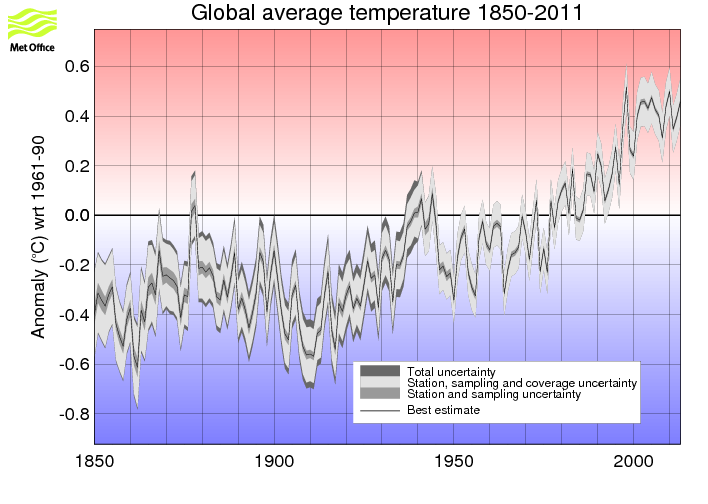

I then obtained some data from the NOAA Satellite and Information Service, as per the NCDC website, of global temperatures over the past 128 years. The line graph of the data points was evident- there was a clear and unabating upwards trend. The service is excellent - the website (link) will plot for you the values of temperature anomalies for any month between Jan 1880 and Dec 2007. Just to be sure I wasn't glossing over any points, I went in for a closer look and made a graph of those points from Jan 1988 to Dec 2007 - 20 years. The graph I made (link) was even clearer. The departures from the average were not decreasing, but rather, increasing in severity. The world is warming. Myth 1 is confirmed. What else do you have for me, Mr. Bolt?


MYTH 2
THE POLAR CAPS ARE MELTING
Wrong. The British Antarctic Survey, working with NASA, last week confirmed ice around Antarctica has grown 100,000 sq km each decade for the past 30 years.
Long-term monitoring by the US National Oceanic and Atmospheric Administration reports the same: southern hemisphere ice has been expanding for decades.
As for the Arctic, wrong again.
The Arctic ice cap shrank badly two summers ago after years of steady decline, but has since largely recovered. Satellite data from NASA's Marshall Space Flight Centre this week shows the Arctic hasn't had this much April ice for at least seven years.
Norway's Nansen Environmental and Remote Sensing Centre says the ice is now within the standard deviation range for 1979 to 2007.

I don't know much about the Arctic, but I did decide to check up on that claim about Antarctica. So I visited the website for the British Antarctic Survey, and yes, apparently, Antarctic sea ice has grown over the past 30 years. However, what Mr. Bolt omitted was that this was due to the impact of the ozone hole over Antarctica slowing the effects of global warming (more detail can be found here). Now unless Mr. Bolt is suggesting we further ozone depletion and subject the human race to all manners of skin disease and cancer, this is not cause for celebration, as all it means is that the ice in the sea around Antarctica has been spreading due to the effect of global warming being delayed (not stopped) by the hole in the ozone layer. To top it off, when I visited the BAS website, I found this article about the Wilkins ice bridge, a 40km long strip of ice pinning the Wilkins Ice Shelf in place, snapping. From the article, emphasis mine: "According to British Antarctic Survey glaciologist Professor David Vaughan the retreat of Wilkins Ice Shelf is the latest and the largest of its kind. Eight separate ice shelves along the Antarctic Peninsula have shown signs of retreat over the last few decades. There is little doubt that these changes are the result of atmospheric warming on the Antarctic Peninsula, which has been the most rapid in the Southern Hemisphere." Check mate, Mr. Bolt. What other myths shall I tackle?


MYTH 3
WE'VE NEVER HAD SUCH A BAD DROUGHT
Wrong. A study released this month by the University of NSW Climate Change Research Centre confirms not only that we've had worse droughts, but this Big Dry is not caused by "global warming", whether man-made or not.
As the university's press release says: "The causes of southeastern Australia's longest, most severe and damaging droughts have been discovered, with the surprise finding that they originate far away in the Indian Ocean.
"A team of Australian scientists has detailed for the first time how a phenomenon known as the Indian Ocean Dipole - a variable and irregular cycle of warming and cooling of ocean water - dictates whether moisture-bearing winds are carried across the southern half of Australia."

Actually, this is correct. Any reasonably in-depth knowledge of Australian history should make this clear. As to whether this particular drought is caused by global warming, that's rather irrelevant- the fact is that the world is warming, and this will not be Australia's last drought.


MYTH 4
OUR CITIES HAVE NEVER BEEN HOTTER
Wrong. The alleged "record" temperature Melbourne set in January - 46.4 degrees - was in fact topped by the 47.2 degrees the city recorded in 1851. (See the Argus newspaper of February 8, 1851.)
And here's another curious thing: Despite all this warming we're alleged to have caused, Victoria's highest temperature on record remains the 50.7 degrees that hit Mildura 103 years ago.
South Australia's hottest day is still the 50.7 degrees Oodnadatta suffered 37 years ago. NSW's high is still the 50 degrees recorded 70 years ago.
What's more, not one of the world's seven continents has set a record high temperature since 1974. Europe's high remains the 50 degrees measured in Spain 128 years ago, before the invention of the first true car.

Again, this is correct, but even more so than the last point, it is irrelevant. What does a freakishly high temperature in the past in one specific location have to do with climate change in the present, Mr. Bolt? The fact that the average temperature of the Earth is increasing does not preclude there being hot times in the past, does it?


MYTH 5
THE SEAS ARE GETTING HOTTER
Wrong. If anything, the seas are getting colder. For five years, a network of 3175 automated bathythermographs has been deployed in the oceans by the Argo program, a collaboration between 50 agencies from 26 countries.
Warming believer Josh Willis, of NASA's Jet Propulsion Laboratory, reluctantly concluded: "There has been a very slight cooling . . ."

On this point, I'm afraid I must most vehemently disagree Mr. Bolt, and again the data is on my side. While I couldn't access Argo data, nor could I find any products that supported or refuted Mr. Bolt. Then I re-read what he said, and found that he didn't even say that Argo indicated such a drop in temperature. Very sneaky, Mr. Bolt! Unsatisfied, I looked for other sources to determine ocean temperature. I found one such source in the form of the National Oceanographic Data Centre, which is operated by the National Oceanic and Atmospheric Organization (NOAA) (yes, the same NOAA whose data is archived by Mr. Bolt's National Climatic Data Centre from the first 'myth'). As shown, the global ocean heat content (i.e. the temperature) has increased and increased (source); the graph is below:


MYTH 6
THE SEAS ARE RISING
Wrong. For almost three years, the seas have stopped rising, according to the Jason-1 satellite mission monitored by the University of Colorado.
That said, the seas have risen steadily and slowly for the past 10,000 years through natural warming, and will almost certainly resume soon.
But there is little sign of any accelerated rises, even off Tuvalu or the Maldives, islands often said to be most threatened with drowning.
Professor Nils-Axel Moerner, one of the world's most famous experts on sea levels, has studied the Maldives in particular and concluded there has been no net rise there for 1250 years.
Venice is still above water.

Since 1993, sea levels have been rising at a rate of approximately 3mm per year, according to both TOPEX/Poseidon and Jason-1. And while sea levels have dropped ever so slightly since 2007, any high school science student will tell you that any small number of data points on a graph are not important; a decrease in temperatures over the past two (or three, to go with Mr. Bolt's figure) years is no more suggestive that levels will continue to drop than it is that levels with jump by 500% tomorrow; all that is important in that respect is the trend, and clearly, the trend is upwards. (Source)


MYTH 7
CYCLONES ARE GETTING WORSE
Wrong. Ryan Maue of Florida State University recently measured the frequency, intensity and duration of all hurricanes and cyclones to compile an Accumulated Cyclone Energy Index.
His findings? The energy index is at its lowest level for more than 30 years.
The World Meteorological Organisation, in its latest statement on cyclones, said it was impossible to say if they were affected by man's gases: "Though there is evidence both for and against the existence of a detectable anthropogenic signal in the tropical cyclone climate record to date, no firm conclusion can be made on this point."

In Year 9 Geography we learnt that the number of cyclones isn't increasing, so I suppose I don't have a lot more to say about that, do I?


MYTH 8
THE GREAT BARRIER REEF IS DYING
Wrong. Yes, in 1999, Professor Ove Hoegh-Gulberg, our leading reef alarmist and administrator of more than $30 million in warming grants, did claim the reef was threatened by warming, and much had turned white.
But he then had to admit it had made a "surprising" recovery.
Yes, in 2006 he again warned high temperatures meant "between 30 and 40 per cent of coral on Queensland's Great Barrier Reef could die within a month".
But he later admitted this bleaching had "minimal impact". Yes, in 2007 he again warned that temperature changes of the kind caused by global warming were bleaching the reef.
But this month fellow Queensland University researchers admitted in a study that reef coral had once more made a "spectacular recovery", with "abundant corals re-established in a single year". The reef is blooming.

I don't know if the Great Barrier Reef is getting worse, but if it isn't, well that's just fantastic news, Mr. Bolt. But what does it have to do with the change in global temperatures? This is still about global warming, isn't it? Also, the website your online article linked to, that of the Great Barrier Reef Marine Park Authority, has a rather large section devoted to how climate change is causing coral bleaching (example). I have no idea why you linked to it- to be honest it wouldn't surprise me if you didn't expect anyone to look there.


MYTH 9
OUR SNOW SEASONS ARE SHORTER
Wrong. Poor snow falls in 2003 set off a rash of headlines predicting warming doom. The CSIRO typically fed the hysteria by claiming global warming would strip resorts of up to a quarter of their snow by 2018.
Yet the past two years have been bumper seasons for Victoria's snow resorts, and this year could be just as good, with snow already falling in NSW and Victoria this past week.

Do I really even have to comment? One year of hysteria due to low seasonal falls has nothing to do with proving or disproving scientific research! My god, Mr. Bolt, this game is starting to wear thin! So long as you keep quoting these unnamed, anonymous 'alarmists', who might as well not exist, how can I rebut you? Your myth busting is ridiculous! I've never even heard this claim being made before! I swear, if I hear one more piece of nonsense from you...


MYTH 10
TSUNAMIS AND OTHER DISASTERS ARE GETTING WORSE
Are you insane? Tsunamis are in fact caused by earthquakes. Yet there was World Vision boss Tim Costello last week, claiming that Asia was a "region, thanks to climate change, that has far more cyclones, tsunamis, droughts".
Wrong, wrong and wrong, Tim. But what do facts matter now to a warming evangelist when the cause is so just?
And so any disaster is now blamed on man-made warming the way they once were on Satan. See for yourself onwww.numberwatch.co.uk/warmlist.htm the full list, including kidney stones, volcanic eruptions, lousy wine, insomnia, bad tempers, Vampire moths and bubonic plagues. Nothing is too far-fetched to be seized upon by carpetbaggers and wild preachers as signs of a warming we can't actually see.
Not for nothing are polar bears the perfect symbol of this faith - bears said to be threatened by warming, when their numbers have in fact increased.
Bottom line: fewer people now die from extreme weather events, whether cyclones, floods or blinding heatwaves.
Read that in a study by Indur Goklany, who represented the US at the Intergovernmental Panel on Climate Change: "There is no signal in the mortality data to indicate increases in the overall frequencies or severities of extreme weather events, despite large increases in the population at risk."
So stop this crazy panic.
First step: check again your list of the signs you thought you saw of global warming. How many are true? What do you think, and why do you think it?
Yes, the world may resume warming in one year or 100. But it hasn't been warming as the alarmists said it must if man were to blame, and certainly not as the media breathlessly keeps claiming.
Best we all just settle down, then, and wait for the proof -- the real proof. After all, panicking over invisible things is so undignified, don't you think?

Ok, that's it. I've had it. Am I insane? Are YOU insane, Mr. Bolt? I have no idea whether or not Tim Costello said that. He probably did. But for crying out loud, since when did one person saying something ridiculous mean that everyone else on his side is so misguided? Anyone with a high school education in science would be able to tell you that tsunamis are due to seismic activity- why tar all with the one brush, eh? Illogical, Mr. Bolt. And then there is your claim from Number Watch. An admirable effort on behalf of the maintainers of that site, but you must understand that none, not a single one of the more outlandish claims made on that list came from a scientific journal. Not one. All from the media. The media reported last year incorrectly that man had found life on Mars- a clearly sensationalist misquotation of a statement of real scientists regarding a completely unrelated topic. The media historically does not report science well. It never has, and that is an unfortunate fact, but it is the fault of reporters, not scientists, those people who have spent half a lifetime devoted to finding the truth about how the universe works, those 'alarmists' you so disrespectfully scorn.


Polar bears are not the symbol of any faith, let alone the 'faith' in global warming. By the way, Mr. Bolt, faith precludes solid evidence, something which is found in great abundance in support of global warming. There is no panic, Mr. Bolt, not any more than is appropriate given the alarming state of world affairs. And to be perfectly honest, I'm sick of your crap. So long as you continue to misrepresent facts and put forward uncited claims, I will find your articles on these topics to be of the greatest offense. Either do some real research and present some reasonable arguments, or continue condescending to people clear far more learned than you, sounding like a perfect jackass, and lose the respect of all students of reality. The warming of the Earth is continuing, and it is due to man. Mr. Bolt, you have been served.


Saturday, May 2, 2009

Homosexuality

A great deal has been said recently about homosexuality, and it seems to, like all politicised issues, descend from discussion to debate to mindless table-thumping extraordinarily quickly with little consideration for thought about exactly what it is that has become such an inflammatory topic of late. It would seem that most of the controversy stems from the accusation that homosexuality is inherently wrong.

My first instinct is as always to challenge this premise. Why would this be so? There seems to be significant evidence to the contrary; homosexuality amongst animals has been documented thoroughly in over 500 species, and observed in another 1000, and humans have been known to engage in homosexual acts since antiquity. In fact, all of the Roman emperors bar Claudius are known to have kept male lovers at some point during their reigns; in ancient times, the distinction between 'heterosexual' and 'homosesxual' was far more blurred. Indeed, the ancients did not even possess equivalent terms, and it was considered unusual for a Roman man not to engage in sexual activities with a man (or boy) as he did with a woman. And of course, lesbianism, though not as well documented, was likewise common (indeed the lesbian poet Sappho was revered as one of the best lyric poets of ancient times).

Similarly, during the classic revival during the Renaissance in northern Italy, homosexuality was known to be widespread. Indeed, since then homosexuality has been documented thoughout recent history, often in spite of social sexual or homosexual repression. And though this does not necessarily mean homosexuality is 'right', it lends strong credence to the notion that to some degree at the very least it is natural.

Considerable opposition to homosexuality comes from religious groups, most of whom cite various scriptures or religious beliefs as explanations for this. If you know me, then you know that this simply does not stick- if something cannot be shown to be right or wrong within the confines of the natural world, then it is not right or wrong in the natural world. Logic and reason should dictate such matters, not the inviolate words of beings who may or may not exist nor persons long dead who may or may not have said such things as they are quoted as saying.

An argument used against homosexuality is that the genitalia of men and women fit together simply far too snugly for anything other than male-female sexual relationships to be normal, an argument which is riddled with fallacy. I could number any amount of objects in my house which could be said to be similarly accomodating, not to mention that the anal cavity is of similar size to the vagina in any case, and even if it weren't this in and of itself would prove nothing of normalcy or rectitude.

More moderate critics might say that what adults do in their own homes is up to them, but that such activities should not be exposed to youths lest homosexuality should be normalised and somehow convince those young people to turn gay or lesbian. Even as a straight man I find this idea to be somewhat offensive; as has been demonstrated above, in terms of nature homosexuality is normal enough. If society is too insecure, fearful or reticent of tradition irrespective of worth to adapt to that then that is indicative only of where society is left wanting.

As to the risk of turning people gay, I can't understand the logical basis for this. Nobody chooses to be gay - if you could choose between being gay and straight with no other influencing factors, why on Earth would anyone choose the potential social ostracism over social acceptance? If one cannot choose to become gay, then either sexuality is hardwired or it is developed in early childhood; I am not expert enough in the fields of sociology or biology to say definitively, but for the purposes of discussing this point, it is not necessary that I am; it would seem to me that exposure to homosexuals is not going to turn anyone, even young children, who would be far too young to understand what they are seeing regardless.

And let's face it: even if this weren't the case, homosexuality would not become rampant. As it is, homosexuality is generally between only 1 and 20% of populations, and any mass conversions or infiltration of society (a charge levelled against those pushing the so-called 'gay agenda') isn't going to change that. Personally, I think that the very idea of straight and gay is an unnecessary one (indeed it has only come into use within the past two centuries) created to suit social perception rather than reality. Considering the multitude of sexual identities in the modern age anyway, it seems almost irrelevant to try and classify people into certain groups when it seems clear that sexuality is not something which easily lends itself to definite classification, seeming to be far more fluid. And ultimately, what does classification achieve? If anything, all it does is make it easier for discrimination and the tyranny of the masses to take hold.

Of course, I couldn't write a piece, however brief, about the status of homosexuality in society without consideration of gay marriage. My point of view is simple, and, as always, it comes down to definition: if marriage is a religious institution, as is so often claimed, and those religions forbid gay marriage, then that seems perfectly alright. However, the State, as a secular body, should not therefore be allowed to wed people, and married people should not recieve any special benefits from the government - in a legal sense, marital status should be something of irrelevance to the government. Irreligious straights as well as gays would be forced to take up civil unions instead; this could very well make it so that the benefits of the married could be conferred indiscriminatorily. But then, if it looks like marriage, and it smells like marriage...

I would venture to say, however, that marriage has become more than a religious instituation, and is now ingrained into all aspects of society. If so, then this robs the aforementioned argument against gay marriage of its main sticking point, and so, all things considered, it would seem like there is little reason to forbid gay marriage. A culture of irrational fear is not something solid enough to build a society on - it's about time people started to realise that.

ADDENDUM: It has occurred to me that in my haste to complete the post, I ommitted a number of points on this topic which I had wished to address, if only briefly. First and foremost, another matter of contention regarding gays is as to whether or not they should be permitted to adopt or in the case of lesbians, recieve IVF treatment. This is a more complicated aspect, I think; individuals should be permitted to do as they wish so long as they don't impact negatively on others. No matter how how good a gay couple might be as parents, in today's society, it would be impossible for a child to be raised by gay parents and not be in some way negatively impacted by it, if only by the consequences of that child being excluded or bullied for their parents' sexual orientation.

It may seem at this point that I would be in favour of preventing gay couples from having children. I do not think this is the answer, however; ultimately, it is society that must adapt to be more accepting - in the case of the hypothetical good gay parents, they have done nothing wrong, and so it does not make sense for them to be punished by the iron boot of social self-righteousness. Irrespective of this, it should be noted that aspects such as social, fiscal, or other standards can negatively affect a child in the same way, something which all parents are equally culpable to. It would seem wrong to prevent poor people from having children, merely because the parents have not, for whatever reason, acculmulated enough wealth throughout the course of their life to afford them another lifestyle. In many cases, such a thing would simply not have been feasible. In a sense, gay couples are in a similar situation - the fact that they are gay is out of their control, and so to prevent them from rearing children on that reasoning would be a flawed approach.

Another major point which I failed to address was the fact that homosexuality and heterosexuality I dislike as terms because they are both exceedingly rigid. The addition of further terms such as MSM and WSW, though permitting better categories for some, further muddy the waters of sexual terminolgy that already include terms such as bisexual and pansexual. Are so many classifications necessary? Why? But this is besides the point; what I seek to point out is that primarily these terms are limited to sexual preference, when in reality the complex situation of love far oftener enters the equation than some of us are perhaps ready to acknowledge, gay or straight alike. It seems cruel at worst and inaccurate at best to so readily discuss the topic acknowledging only the sexual side. The fact is, gays fall in love as straights do. For people who hear me speak my opinion relatively often may this may seem an unusually emotional argument coming from me, but even so I feel compelled to bring it up: how can anyone deny someone the rights and recognition they deserve on, of all things, what must be truly the most sacrosanct human emotion? People can't help the way they feel, and the idea that what would have to be, if one is to be selected, the holiest of all emotions, which in some manifest form is surely felt by all of us, as one underlying current of togetherness that conflates our common humanity, is used as an excuse to further intolerance must surely be one of the most absurd statements I have ever come across in the short time of my being. And on that note, I bid you, my devoted readership, adieu.

Saturday, April 4, 2009

Easter service

Yesterday, as a matter of course I attended a church service for the beginning of the Easter break. Due to no fault of those running the mass (except perhaps for the dramatisation of the denial of Peter, which was... interestingly executed) my experience was less than pleasant up until the point where the guest minister, who ordinarily takes mass at that church, made an 'Easter address'. From speaking to a good number of people afterwards, I found many people to have found it exceedinly unsatisfactory, as did I. Though my memory is not as sharp is it was a day ago, I will try to list and address some of the Reverend's points.

First of all, the Reverend went to quite a bit of trouble to make sure everyone present did not think he was delusional, repeating quite a number of times (an unnecessary number of times, to be honest) that from his own and presumably our experience, we do not generally see dead people amongst the living. While this is true enough, where he went from there somewhat upset me. He stated that likewise, the Apostles believed that Jesus, having been crucified, was dead and gone. And so, to suggest that Jesus was not resurrected would be to accuse them of being simpletons and imbeciles as they claimed to have witnessed him in the flesh and heard reports of his tomb left empty and bare, as if they were not capable of comprehending death. He then went on to say that we in the 21st century were not so much smarter than those in the 1st century (and if he is referring to capacity for intelligence rather than knowledge itself, then I agree wholeheartedly) and was quick to denounce anyone foolish enough to think we are so much smarter than they were. He may have even been alluding to the fact that knowledge is not learnt and forgotten, but constantly built upon; it would take just as long today to deduce Pythagoras' Theorem as it did for Pythagoras himself if we had the same degree of mathematical knowledge, after all.

The problem is that though this argument is at first compelling, it is seriously flawed, and while his secondary point is valid, he disgusts me the way he uses it. If everything in the Bible was true (an impossibility due at the very least due to discontinuity) then perhaps to suggest that Jesus didn't rise from the dead would be an insult to those first disciples; but the Bible cannot be entirely infallible, and even if it was a reasonably accurate account of what it is supposed to, even then by the very fact that it should be claimed as a historical source it must be taken with a grain of salt, because we cannot be sure now what happened 2000 years ago: this is a very basic tenet of historical study. No source can be trusted entirely.

Now, naturally, people don't think that disbelieving in Jesus is supposed to be insulting anybody, not by itself, and so one might expect their reaction, after the original knee-jerk of embarrassed shame, to be to question the premise of the claim, as I have. This is why he brought up the second point; before anyone has the time to question it, he throws in as evidence a fact. That the fact happens to be irrelevant given that the premise is false is inconsequential so long as the premise is not questioned; in the oppressive and stifling environment of a church packed to if not beyond its maximum capacity, few will bother to take the thought any further, and so will be taken in. It's dishonest and insulting to say the least, but keep in mind that the tactic he used, a distraction, is one used in so many persuasive features subconsciously that I shouldn't be surprised if he did it without thinking. And given his job requires proselytisation, he can almost be forgiven for giving it a go.

However, the fact remains that people do not like to be converted; conversion requires renunciation of previous beliefs, and so can only occur on the prior assumption that they are false, and people do not like to be told that what they believe is incorrect, which is something I try vehemently to avoid. An open minded person will be open to discussion and discourse, but nobody would openly seek conversion- that would defy logic. I think this is why many people were upset, as I was (but many even more so) by the sermon. But it did not end there.

While naturally there were other less important parts of the sermon in between, his next major, and by my memory, final point was that the explosion of Christianity throughout the Middle East and Europe in the first century could only be logically explained by the fact that the Resurrection must have been real; otherwise, how could so many people believe it? This point is ridiculous to say the least. First of all, was there an explosion of Christianity in these places in the first century? As I'm not an expert, I do not know, but from what I do know, though Christianity was somewhat popular at the time, especially in the Holy Land, its influence was not nearly so great as has been suggested here. And even if the extent of its spread was greater than I understand it to be, I can guarantee that its truthfulness is not the only, or even one explanation as to why. Aristarchus of Samos proposed that the planets went around the Sun around 270 BC, and it took 1,800 years for that fact to be widely accepted- why then should any other fact necessarily be spread quickly simply because it is true? Furthermore, one would expect that if it spread because it was true, then it should have been accepted at a roughly approximate rate. However, Christian beliefs spread throughout Jerusalem much quicker than in Italy, and much quicker in Italy than in Gaul, and so on. As I have said, I am not an expert, and my research revealed little as to why there should be or should have been any particularly large spead of Christian belief throughout Europe, so I cannot claim to say why it did spread if it did, but if you are interested to know, reader, find an expert and ask them.

Throughout other points in the sermon the Reverend claimed that the belief in death as being final and eternal and above all, unconquerable, was not a wise one as there is no way for it to be proved. If he was referring to an afterlife, then he is correct. However, in the end, the decision should be made according to Occam's razor: what evidence do we have that death is final as opposed to a part of some greater cycle or lifespan? None either way, for such things cannot be proven by evidence, much like God cannot be proven nor disproven. And so, taking this into account, according to the principle, which is the simpler (and therefore more likely to be correct) explanation- that there is nothing after death, or that there is an afterlife? Given that by definition nothing must be simpler than something, that would be the more likely explanation, all things being equal. How then, can logic support him when he says otherwise?

Of course, he could have been referring to literal resurrection, but this can be dismissed easily enough. According to scripture, if my knowledge is not too rusty, the only people to be resurrected in the New Testament were either those resurrected miraculously by Jesus, or Jesus himself, who happened to be the Son of God and so perhaps is a special case. And so, by Christian teaching, death is inconquerable unless you happen to come across the Son of God, or be him. If you do not believe that the Bible's account is accurate, then you simply remove that provision and find yourself to be in agreement regarding the other 100 billion or so humans to have ever lived, and so his claim that nonbelievers are excessively "dogmatic" in the belief in the finality of death would be entirely moot.

Naturally, had it been a private conversation instead of a church sermon, I might remember the specifics better, or even have recorded them, and would have come out of the session no doubt far more enlightened than irritated. However, this was not the case, and so if anybody who was present has an issue with my recollection or thinks that I have missed an important point, or would like to simply comment of the Reverend's comments, leave a comment below and I will address it as necessary.

Saturday, March 28, 2009

God

When considering one's belief in a god, one must first establish that there is a god for one to believe in. This may seem like a simple task, but if one lends sufficient thought to it, one realises that before one can even begin to do this, he must first define what a god is.

Before you have much of a chance to conjour your own response, first let me paint a picture for you, a picture which began my own reflection on the subject. You're walking along a rather small beach. There's no surf, and it's not particularly warm, but this means the beach is empty and you have an opportunity to collect your thoughts. This beach happens to be covered in many small rocks and pebbles, as many beaches are. For no reason in particular, perhaps to marvel at its colour or simply to skip it along the sparkling surface of the sea, you pick up a rock at random. Upon closer inspection, you find nothing remarkable about the rock whatsoever- it is a smooth rock, and flat, an inch across with a dark, dullish grey colouration. Your first instinct is, perhaps, to drop it, or throw it; after all, it holds no significance to you.

But then, for no reason in particular, you ponder the rock. Your thoughts were adrift, and they happened to float upon the topic of the small object in your hand. Where did this rock come from? You look around- the sea, most likely. After all, it is smooth. You know that exposure to the waters of the ocean would do that to a rock, eroding it until it became smooth. So the rock came from the sea. Most likely it came from nearby, perhaps it has always been here, perhaps it, over time, was pushed down the beach from some other location. Or perhaps it came from much further out to sea, or even from across the sea, from some peninsula somewhere. How long would it take for such a rock to travel 100 metres down the beach, let alone across the ocean?

At this point, you are struck by a certain feeling, a feeling you are not familiar with. You realise that this one, small, tiny and insignificant rock is so much older and has travelled so much further than you, and from wherever it came, having left however long ago, it has come to you, you of all people, and is now sitting in the palm of your hand. In less than a century, you will be dust, but this rock, who knows? It could be somewhere else, to lie in someone else's hand. You feel insignificant compared to this thing which easily fits into the palm of your hand. This feeling that fills you, to say it was magical is to belittle it: it is more than that. It is a sliver of revelation. You see in this simple object something special, and you look up, and see hundreds of rocks upon thousands of grains of sand. You are overcome with awe, and feel that you are in the presence of divinity. But this is only a shadow; in the whole universe, you are standing on a small beach in on the edge of some continent on a backwater planet in an insignificant system in an unremarkable galaxy, one of hundreds of billions.

So, you acknowledge that something special has happened, something perhaps godly. But what is it? Well, what has happened? You've realised something, pretty much. So then that then begs the question as to whether or not the feeling you have encountered stems from without or within. If we assume that this experience really has to do with some sort of god, and we thus extrapolate our experience to the point of 'godliness', then it leaves us with perhaps two options. Either these rocks, and these grains of sand and all the rest, are God, and from your consideration, you have seen a hint of this godliness, or your knowledge is a hint of this godliness, and hypothetically, were you to gain a great enough understanding, you would be God, or at the least, a god.

I considered both, myself, and found the second one did not sit well with me. I thought that only a god could truly appreciate the whole of the universe at once, but having that ability does not make one a god. Consider if a human could achieve this. Yes, he may have unlocked the secrets of the universe, no mean feat, but he would not have any practical use for this. He would not be omniscient, omnipresent or omnipotent. He would, for all intents and purposes, have the potential to be a god, but potential alone is not enough to grant one such a status, if it were possible to do so in the first place. Hypothetically, he would be no better equipped for detecting or even defending against a person sneaking up behind him with a knife, and would be just as mortal as the rest of us. Though perhaps infinitely enlightened, such a person is not a god, and so we can discount that alone as being a critereon for divinity. That leaves the first option, whereby the universe is God, or perhaps is a part of God or a manifestation of God.

Naturally, my little story alone is not sufficient to determine which of these three is the best answer. As a matter of fact, it works only on the premise that there is a god to be considered, when in fact the case may be that there is none. I will touch on that more soon, but I think it best that we continue with the presumption that there is a god or gods, for now.

Where we go from here is a matter of personal preference, but as this is about my philosophy, I will kindly show the way. I will state now that I do not believe in any personalised god. This includes Jehovah, Jesus, Allah, Ganesh, Zeus, Jupiter and Odin, though I do recognise of course that Jesus was a real person. Allow me to explain why: on a most simplistic level, I have no need for a personalised god. Naturally one might say that one has no need for the colour blue, and though this may be true, it does not mean that blue does not exist. However, there is no evidence for a personalised god such as there is evidence for blue, that being solid and undeniable; in fact most modern religions rely to some degree, some almost entirely, upon the concept of faith, which is belief in spite of a lack of evidence, or to some, belief in spite of evidence to the contrary. I must admit that I find this concept somewhat suspect, and I will delve into that shortly. First of all, though, I must level my greatest criticism of the personalised god. Through all of my research, I have not found a god who was truly logical. Every god I read about acted in a fashion which was secretive, deceptive, roundabout, and all for reasons which themselves were indirect and unnecessary. Why, for example, does not God simply reveal His existence to us? As a test of faith. But why must we have faith? Because God does not reveal himself to us. Examples of circular reasoning of this kind permeate almost every religion on Earth to this day. If one looks back in history, one finds that many philosophers have looked for reasons to explain god unto man, some of which are astounding in the lengths they go to in reading logic into the illogical. While one must admire them for their effort, one must question why a god would not be logical. But now I must check myself, for I have not explained why I believe a god must be logical in the first place- the reason is simple. The universe follows a set of rules, rules which we are able to deduce through logical means. I cannot accept that there would be a god who would create such a universe and then go out of his way to act at such odds with his creation.

So why would a god not be logical? The simplest and most reasonable explanation is that the god was made by man. If one were more hesitant in their blasphemy, they might suggest that god has merely been corrupted by man, but the effect is the same- the gods people worship are not true gods. One only has to look back into history to see this creation or corruption happening consistently whenever something occurs which goes without rational explanation. When the ancients felt an earthquake, they could have no comprehension of the movement of tectonic plates, and so they did the best they could- they deduced that a god had caused the earthquake. And judging by the devastation, he was mad, punishing them perhaps. If one looks carefully, excepting certain times and places, such as periods in Ancient Greece and Rome, the medieval period and more so, the Enlightenment in Europe, one finds that most major progressions in theology occur after natural events given supernatural explanations. This so-called 'god of the gaps' is inefficient and illogical because it is necessary, else it could easily be explained away. This is a root of another of my major criticisms of certain modern religions. People should not be compelled to do good through fear. People are perfectly capable of acting morally and ethically in both peace and harmony without the threat of some horrific, eternal punishment. Jesus' message of love and acceptance, for example, is often mixed inextricably and perhaps tainted by the threat of Hell. Fear is only necessary as a means of control, for a people without fear of retribution for deserting a religion will look for their own explanations of right and wrong. One pertinent example might be the Reformation, where people who looked for their own interpretation of God, despite having found one astonishingly similar in many way to the Catholic conception, were actively persecuted all the same: when supernatural fear is not enough to dissuade dissenters, perhaps some more mortal pain is in order, it would seem. Fear comes from and breeds hate, and it should not be the basis upon which a religion is founded, but I will go into this in greater depth in Part Two. However, this is Part One, and it is about God, not religion.

Fear of god is also important for reverence, for after all, a personalised and sentient god would be perfectly capable of striking you down if you do not obey him. If one fears death, and especially Hell, then one will try and avoid this. But a god so hell-bent, if you'll excuse the choice of language, on punishment is not a kind god, and it is of my opinion that if your god is omnibenevolent, he must be kind. You might say that he is not kind to test us, but I have already touched on illogic above. The God of the Old Testament, Jehovah or Yahweh, is not a kind god. He is cruel, vain, and at times even sadistic. Of course, not all profess to have benevolent gods, so that, it would seem, lets them off the hook for now. However, I cannot accept that any god would try to hurt his creation in any form, and I cannot accept that this harm is for the good of that creation. If one were to beat a child, one would be sent to jail for a very, very long time, and arguing that it was for his own good would not justify it in the least.

And then there is the matter of the sheer number of gods. If one accepts one god over others, one must ask why. The Christian might say that it says so in the Bible, but of course it will- if the Bible said that God was nonsense, then it wouldn't be the Bible. Lacking any hard evidence, the same evidence I speak of when referring to the analogy of the colour blue above, that being verifiable beyond doubt ('miracles' or personal revelations do not count, I am afraid, for they persuade only prior believers), one must accept all gods as potentially being true, equally so. Taking the argument from inconsistent revelation, one finds that simply given the sheer number of gods (and interpretations of god within the one religion), the odds of selecting the 'right' god to worship are simply astronomical. From this point of view, it makes little point which god one worships as most likely one will ultimately be sent to some sort of hell in any case. If deciding what god to worship becomes a matter of inconsequential trivium, then one must acknowledge that the worship of any god becomes unnecessary, especially when doing so will most likely cause you to act in a manner you might not like. Though I do not particularly like him, I feel a quote by Richard Dawkins is relevant here: "We are all atheists about most of the gods that societies have ever believed in. Some of us just go one god further."

Of course, there are some personalised gods to which most of the above criticisms do not apply. Deism is one of them, which believes in a singular God who created a self-governing universe and then left it be. I admit that this is somewhat appealing in the light of the above, but there is one problem I find with it- why? I hate to bring up Occam's Razor, as it is too often misquoted and misconstrued to support arguments where it oughtn't be used, but I think it applies here. If one can observe only the universe, and the universe is self-governing with no interaction with God, then why even bother believing with God? There is no need for him but to explain why the universe began, which makes him simply another god of the gaps. To an extent it seems like retaining tradition for the mere sake of retaining tradition, which is ridiculous to say the least.

So, if we discount the personalised god, what are we left with? If a personalised god is sentient, all-knowing, all-powerful, everywhere and nowhere, existing beyond time and yet for eternity, of flesh and blood or of the ether, then what god is there that is not personalised? I now ask you to cast your memories back to the start of this text, where I told you the story of the person on the beach, and before that, the question of what defines a god. Having reached this point in our reasoning, these two things become suddenly important. The question of a definition spawns the question of, if a god is not these things above, then what is it? And I will attempt to answer it using that story I told you.

I take a small tangent here when I say that during my research, when researching stoicism, I found the stoics' beliefs to be particularly interesting. Regarding cosmology, most of their beliefs would now be discounted as nonsense, especially regarding the elements. What did influence me, however, was their conception of Logos. What their idea of Logos was is not particularly important in this context, for I did not adopt it; rather, it sparked a thought which I carried through to a point where it touched where I last left our reasoning, regarding the nature of the universe and God.

The thought was this: what if, rather than a God creating a self-sustaining universe, something I touched on earlier, what if it was this self-sustaining nature, this driving force which made the universe work, what if it was this which was God? Immediately this appealed to me, as it was a thought I had not encountered before. Clearly, as I mentioned, the universe works according to a number of rules, rules which we have observed and deduced via scientific means. It may seem strange to you, but I assure you that this is due merely to my inability as a writer to describe it, when I suggest that it is the force behind these rules, this innate driving force which is God. It does not think or do, it simply is, and its being is sufficient to cause the universe to work. The analogy of the watch might better explain it: if what we see on a watch, the ticking of the hands, is the observable universe, and the cogs and wheels inside the watch the laws which govern the universe, causing what we see to occur, then this God would be the electricity which makes those cogs move; in the same way, this God is the force which causes the universe to work. If we now relate this to our story, we can marry the two concepts: what we have seen from our consideration of the rock is, for a split second, a hint of this force.

While this appeals to me, I must admit that from the start there was one feeling nagging me as I concieved it. What need was there for it? Perhaps there ought to be some universal god as I hypothesised, but that doesn't mean that there is one, and even if there was, what then? No religion could possibly be founded upon it- how does one pray to an entity with no concpetion of itself, let alone you?

I have up until this point chosen to dance around my actual beliefs, preferring instead to explain the journey I took in reaching them, in a perhaps too indirect fashion to keep your interest. If so, fear not, for we have now reached the business end of the work.

There was only one satisfactory explanation I could find after my journey. That Nature and God are inextricably linked. For the universe is so wondrous, how else could such divine beauty exist but were it God itself? I personally cannot help but marvel at the mysteries of the universe, and this idea was the only one that could explain this higher feeling to me within the confines of my aforementioned preconditions. Some would say, quite correctly, that this would make me a naturalistic pantheist. But this somehow seems wrong to me. I can accept that there is something higher, above me, almost spiritual in a sense, and to say that it is divine. But it is a God in words alone- it cannot be worshipped. How can one believe in a god and be irreligious? So, somewhat paradoxically, I believe that this 'god' of the universe does and does not exist. For belief in this god in no way affects my thoughts or actions, except indirectly in my shunning of all other gods in preference to it. It is almost not fair to call this god, and I do so almost out of convenience alone, as it cannot be described as a being of any kind. So in a sense I am caught in between my disbelief in personal gods and this believe in a wondrous universe, trapped by words of unclear meaning and use. But ultimately what I call it does not matter. So long as I know, and you know what I mean when I speak of this God, then it makes very little difference indeed.

I will add on one more thing as an addendum: one reason I sometimes refer to myself as a nontheist, besides to resolve the awkward paradox above, is that most people would not consider such a passive deity to even be a god. If I accept this, then I cannot say I am an atheist, for I do not disbelieve in a god, nor would I profess to be an agnostic, though I accept that it may be the case that some things may be unknowable, for the reason that I think what is unknowable is often largely irrelevant. If I cannot know if there is an afterlife, why should I bother considering it? "Nontheism" is sufficiently broad to cover my position for informal discussion.

Additionally, I freely admit that throughout this work I have gone in search of God, and I recognise that it is all based on one, admittedly possibly flimsy presumption: that one finds majesty in the consideration of the rock. I am well aware of the possiblity that one might have no interest in the history of the rock, and no care for the stars above us. I likewise admit that there will be people who will criticise me and say that my belief in a higher entity is the exact illogic I deny others, and that these feelings of mine are incompatible with my thoughts of deities. For the present, I will say that those statements are valid, and I have considered them greatly, for I cannot honestly say to know the Truth. Only when the Truth is known will thought be unnecessary, and so for most likely the rest of my life, I will continue to reflect on the nature of God, and perhaps find my beliefs will change over time, as they have already. I am greatly looking forward to Part Two, in which I will go into a complementary topic which ought to dicuss a great deal I have omitted here which may serve to fills any and all gaps I have left in this, Part One, regarding my philosophy.

Introduction

I imagine you're wondering two things. First of all, why would I write a blog on philosophy? and second of all, why I would write a blog on philosophy?

The answer to the first question is one I intend to expand upon in the blog itself, but I will briefly touch upon it now. I'm not an old or particularly experienced man. No single event has changed my life, or taken me near to death. I have no doctorate, I have not travelled the world. I'm young, and I don't have all the answers. You might expect some text on philosophy to be written by an aging man, some sage or guru perhaps, a man of religion possibly. I am not he. What I am is a young man who likes to think. I think compulsively, and what better a topic to mull over than what I see around me? I am well-read, but I form my own ideas based on my own experiences, limited though they may be. And though they may be limited, I have seen and heard much. It is not difficult to absorb a lifetime's information in weeks and months in the modern era, if one compares the modern man with his information superhighway to, say, a medieval peasant, who not only lived shorter but possibly never left his home town. When put like that, a lifetime's information is not a great deal at all. I think this is enough for me, sufficient reflected upon, to form some sketch, some scaffolding of ideas upon which a belief system might be lain.

That leaves the other question. This one is perhaps a little harder to answer. I mentioned that I think compulsively. But what good are thoughts, if they can only benefit oneself? I have a deep-seated conviction that others should be told of what I think, even if they are unwilling or my words impotent and paltry. Why this should be so, I am not sure, but it is as it is and there is little I can do otherwise. I am going to great pains now to tell you that I do not pretend to think my words will change anyone's life bar my own. But at the same time, I should like to think that maybe someone will read what I've read, and I will leave an impression, if only passing, that would make them think again. Perhaps this is my deeper goal- my life revolves so certainly around thinking that I derive a great deal of pleasure from it, and, like laughter, I think thoughts are best shared with friends. If thought inspires thought, then perhaps I can cause you, reader, to experience the same intellectual fulfillment that I do.

But this blog is not supposed to be a pamphlet on my beliefs- I am no preacher. I will leave some commentary from time to time on current events, perhaps some art or poetry, but with that said, this blog is called My Philosophy for exactly the reason that it describes its content. I do not want anyone to wholheartedly subscribe to what I think, but as I mentioned, I would like to think I can leave some impression on somebody, and that would make all the difference. So, I hope you enjoy reading what's to come.